Subscribe
48°

Madison Hit By Outages As 27K Lose Power Across CT
More than 27,000 Eversource customers were without power across Connecticut on Sunday morning, Sept. 27, as a powerful Nor'easter continued to batter the state.
Eversource reported 27,315 customers without power, with outages spread across dozens of communities as of 8:45 a.m.
Among the hardest-hit towns were Watertown, with 1,223 customers without power; Lyme, with 1,069; Clinton, with 1,003; New Canaan, with 956; Mansfield, with 876; and Old Lyme, with 810.
Waterford had 702 outages, Thompson had 619, Stafford had 519, Killingworth had 505, Madison had 495, Killingly had 490, Wilton had …
Latest Town-By-Town Snowfall Totals As Massive Storm Slams New Haven County, Tristate
Here's a rundown of updated snowfall totals from downstate New York, northern New Jersey, and Connecticut for a historic, massive Nor'easter that arrived Sunday night, Feb. 22, continuing into Monday, Feb. 23.
Some spots had already seen as much as 20 inches by mid-morning Monday, and approached 30 inches later in the day.
Central Park in Manhattan recorded 19.7 inches, making it the heaviest snowstorm for the city in over five years and nearly approaching all-time records.
Over 650,000 customers lost power across the region, with the heaviest outages concentrated in New Jersey, Massachuse…
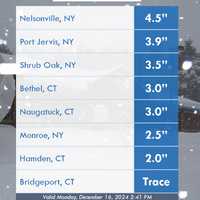
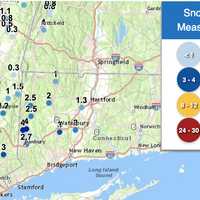
Naugatuck Tops New Haven County Snow Totals With 3.0 Inches
The National Weather Service has released snow totals from this week's winter storm.
Snowfall accumulation impacted areas across New Jersey, Pennsylvania, Connecticut, and New York, with Sussex County, NJ, and Putnam County, NY, seeing the highest totals from Sunday, Dec. 15 into Monday, Dec. 16.
Below are detailed figures reported by state, county, and town, as per the National Weather Service:
New Jersey
Mercer County:
Trenton Mercer Airport: Trace (11:59 PM, 12/15)
Morris County:
Butler (1 S): 3.0 inches (5:15 AM, 12/16)
Sussex County:
Wantage Twp: 4.1 inches (5:00 AM, 12/16)
Wan…